Material Verification Services
Positive Material
Identification
- Alloy verification for identified components
- Method selection based on required elements
- Traceable results for your material records
Inspection Snapshot
Check the alloy before installation or use
Alloy Verification
Compare measured elements with the specified alloy.
Material Sorting
Separate mixed or unidentified metallic components.
Documented Results
Connect chemistry readings to individual item identifiers.
Discuss your inspection
Certified Personnel
Qualified NDT professionals
Fast Turnaround
Responsive scheduling
Modern Equipment
Calibrated UT instruments
Detailed Reports
Clear inspection findings
Component preservation
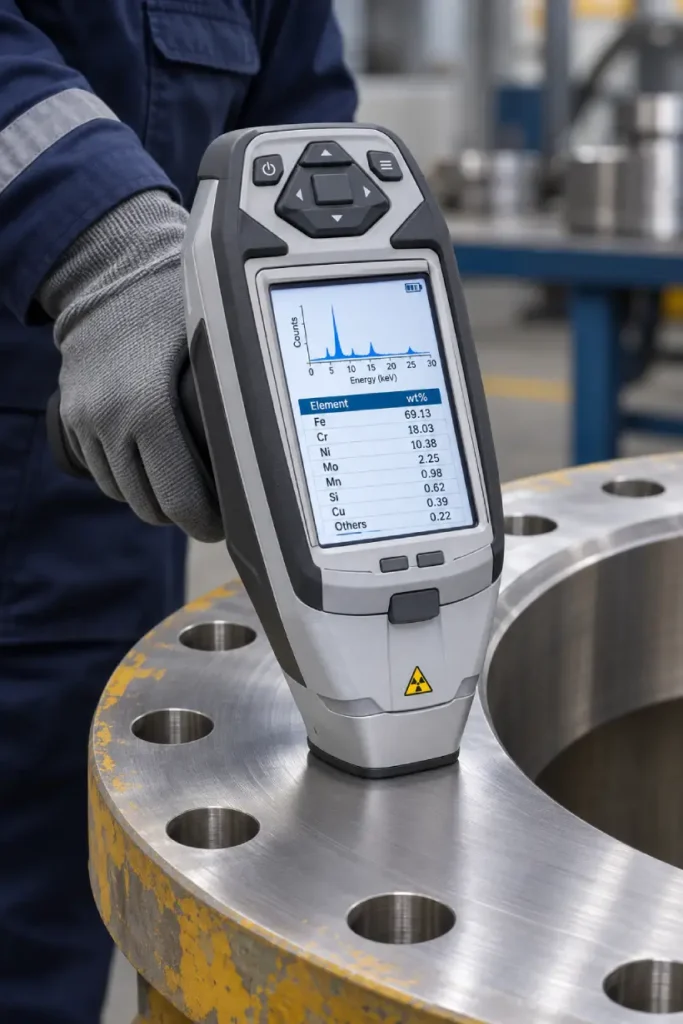
Handheld XRF usually leaves no test mark on a clean surface. Grinding for preparation and spark OES analysis can leave local marks.
 What is positive material identification
Verify chemistry against the intended material
Alloy verification
Weld metal checks
Incoming materials
Mixed stock sorting
Component traceability
Material investigations
--------- Our Process ---------
A controlled check from item identification to report
Scope Review
Confirm the specified grade, required elements, quantity, sampling coverage, component access and acceptance limits. Review material certificates where available.

Method and Surface Preparation
Select an appropriate technique and verify performance with suitable reference materials. Prepare the test surface to limit coating, contamination and geometry effects.
Analysis and Traceability
Measure the identified items at agreed locations. Record the instrument method, relevant readings and item references; investigate unexpected results.
Evaluation and Report
Compare the measured chemistry with the agreed criteria. Clearly distinguish an alloy-family match from a complete grade or product-specification verification.
--------- Inspection capabilities ---------
Material verification across the supply chain
Incoming Material Verification
Check selected items against purchase specifications and material records before release to production.
Piping and Pressure Components
Assess suitable pipes, flanges, fittings and valve bodies for consistency with the specified alloy.
Weld Metal Verification
Check accessible deposited weld metal where chemistry, weld size and measurement geometry permit a representative result.
Stainless and Nickel Alloys
Differentiate many alloy families using measurable elements such as chromium, nickel and molybdenum.
Mixed Material Sorting
Screen identified batches for alloy mix-ups and separate unexpected materials for further review.
Laboratory Chemistry Follow Up
Use appropriate additional analysis when carbon, trace elements or a more complete composition is needed. Laboratory and field arrangements are confirmed in the quotation.
--------- Discontinuities and Findings ---------
What PMI can identify
Wrong alloy families
Mixed material batches
Unexpected alloying elements
Inconsistent accessible weld chemistry
Discrepancies with specified chemistry
Items requiring further laboratory analysis
Heat treatment
Corrosion resistance
Full product-standard compliance
Prove strength
--------- Codes & standards ---------
API RP 578
Material verification programme guidance where specified.
ASTM E1476
Metals identification, grade verification and sorting.
ASTM E415
Spark OES for applicable carbon and low-alloy steels.
ASTM E1086
Spark OES for applicable austenitic stainless steels.
Product material specification
Required chemical limits for the identified material.
Approved project procedure
Sampling extent, item identification and reporting rules.
--------- Industries served ---------
Supporting quality and asset integrity

What our clients say


 Trustindex verifies that the original source of the review is Google.
 Trustindex verifies that the original source of the review is Google.
 Trustindex verifies that the original source of the review is Google.
 Trustindex verifies that the original source of the review is Google.
 Trustindex verifies that the original source of the review is Google.
 Trustindex verifies that the original source of the review is Google.
 Trustindex verifies that the original source of the review is Google.

 Trustindex verifies that the original source of the review is Google.
Frequently asked questions
Answers before you schedule
Can handheld XRF measure carbon?
Can XRF distinguish 304 from 304L or 316 from 316L?
Does PMI replace a material test certificate?
Can PMI be performed on site?
How much surface preparation is required?
The test area must be representative of the intended base or weld metal. Paint, plating, corrosion, contamination and unsuitable curvature can affect readings. Local cleaning or grinding may be required.
--------- Need an inspection? ---------
Verify the material behind the part number
Contact CMH NDT Services Plan your inspection
- Phone: 647-365-0906
- Email: info@cmhndt.com
- Service Area: Ontario and across Canada
- Availability: Laboratory and on-site services