Conventional NDT Services
Radiographic
Testing (RT)
- Internal weld and casting examination
- Traceable inspection records
- Inspection planning to suit your project
Inspection Snapshot
A clear picture of internal quality
Weld Examination
Assess suitable welds for internal discontinuities.
Casting Evaluation
Identify porosity, shrinkage, inclusions and internal voids.
Image-Based Records
Document the examined area for interpretation and future review.
Discuss your inspection
Certified Personnel
Qualified NDT professionals
Fast Turnaround
Responsive scheduling
Modern Equipment
Calibrated UT instruments
Detailed Reports
Clear inspection findings
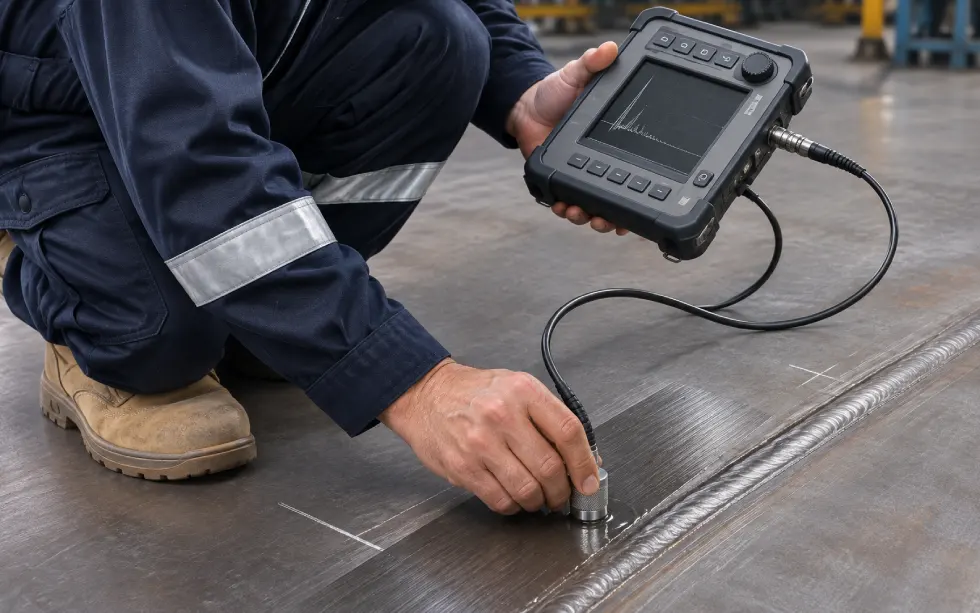
Non-Destructive
Inspect internal integrity while keeping the component usable.
 What Is Radiographic Testing?
Reveal internal conditions beyond the surface
Radiographic Testing passes X-rays or gamma radiation through a component onto film, an imaging plate or a digital detector. Differences in material thickness and density create an image that qualified personnel interpret.
Recording methods include conventional film, computed radiography (CR) using scanned imaging plates, and digital radiography (DR) using electronic detectors. The technique available for your project will be confirmed during quotation.
Weld examination
Casting inspection
Porosity detection
Internal voids
Shrinkage evaluation
Quality verification
--------- Our Process ---------
A controlled inspection from planning to report
An effective RT examination starts with a defined scope, suitable exposure technique and coordinated radiation safety arrangements.
Scope Review
We review drawings, materials, access conditions and acceptance criteria.

Technique and Safety Planning
Establishes the recording method, exposure geometry, image quality requirements and site controls.
Exposure and Image Review
The examination area is identified and exposed using the selected technique.
Evaluation and Report
Qualified personnel interpret relevant indications and evaluate them against the specified acceptance criteria.
--------- Inspection capabilities ---------
Radiographic examination for critical components
Pipe and Pipeline Welds
Examine suitable circumferential and longitudinal welds for internal discontinuities, with exposure arrangements selected to achieve the required coverage.
Pressure Vessels
Evaluate accessible vessel welds and selected components against the applicable construction code and project specification.
Structural Welds
Examine suitable structural steel weld configurations where radiography is specified and source and detector positioning are practical.
Castings
Assess suitable cast components for internal porosity, shrinkage cavities, inclusions and other manufacturing discontinuities.
Valves and Fittings
Inspect suitable cast valve bodies, fittings and welded connections where component geometry permits meaningful radiographic examination.
Repair Verification and Investigation
Examine repaired areas or investigate suspected internal discontinuities to support decisions on further testing, repair or acceptance.
--------- Discontinuities ---------
What radiographic testing can detect
Gas porosity
Slag inclusions
Incomplete penetration
Lack of fusion
Cracks
Internal voids
Casting shrinkage
Material thickness
Geometry
Size and orientation
--------- Codes & standards ---------
ASME Section V, Article 2
Radiographic examination methods and technique requirements.
ASME B31.1 / B31.3
Power piping and process piping requirements.
API 1104
Welding and examination of pipelines and related facilities.
AWS D1.1 / CSA W59
Applicable structural steel welding inspection requirements.
ASTM E94/E94M
Guidance for examination using industrial radiographic film.
ASTM E1742/E1742M
Radiographic examination practice requirements.
--------- Industries served ---------
Supporting fabrication quality and component integrity

What our clients say


 Trustindex verifies that the original source of the review is Google.
 Trustindex verifies that the original source of the review is Google.
 Trustindex verifies that the original source of the review is Google.
 Trustindex verifies that the original source of the review is Google.
 Trustindex verifies that the original source of the review is Google.
 Trustindex verifies that the original source of the review is Google.
 Trustindex verifies that the original source of the review is Google.

 Trustindex verifies that the original source of the review is Google.
Frequently asked questions
Answers before you schedule
Does radiographic testing damage the component?
Is RT safe on an active site?
RT requires a controlled exclusion zone, restricted access, radiation monitoring and coordination with the site supervisor. Nearby work may need to pause. Off-shift or shutdown scheduling may be necessary to maintain safe conditions.
Work must follow the applicable licensing and personnel requirements. For gamma exposure devices in Canada, operators must hold CNSC certification or work as trainees under the required direct supervision.
How long does film interpretation take?
Can you do RT in the lab?
When is RT preferred over UT or PAUT?
--------- Need an inspection? ---------
Get a clearer picture of internal quality
Contact CMH Metlabs
Plan your RT inspection
- Phone: 647-365-0906
- Email: info@cmhndt.com
- Service Area: Ontario and across Canada
- Availability: Laboratory and on-site services
Tell us about your job
By submitting you agree to be contacted about your request. We never share your details.